
FAQ
Manage company EV charging, track usage, and get automated monthly invoices.
Circle Link simplifies fleet management, employee access, and cost control.
DAEI is the Lithuanian system of accounting units for fuels from renewable energy sources, designed to promote the use of renewable energy in the transport sector.
Electricity used to charge electric vehicles and meeting DAEI requirements may be included in DAEI accounting. Private EV users can participate in the system through an aggregator.
Circle Link acts as a DAEI data aggregator. The system collects charging station data, verifies and administers it, and submits the relevant data for DAEI accounting.
The user does not need to register each charging session or manage DAEI units independently.
Currently, for every kilowatt-hour recorded by Circle Link and accepted as eligible under DAEI rules, you can accumulate a €0.036 DAEI benefit per kWh.
For example:
* 300 kWh per month – €10,8
* 500 kWh per month – €18
* 700 kWh per month – €25,2
The actual benefit depends on the amount of electricity actually charged and recognised as eligible for DAEI accounting.
No. You charge your EV according to your own needs.
The more electricity eligible under DAEI rules that is used to charge your EV, the higher the potential accumulated benefit.
Usually, no.
You can charge your EV whenever it is convenient for you. DAEI is not an electricity tariff, so the system itself does not require you to charge at specific times or according to Nord Pool electricity prices.
It depends on the charging station manufacturer, model, and its technical data transmission capabilities.
Circle Link may collect data via OCPP, the manufacturer’s API, an electricity meter, or another suitable technical data source.
If you are unsure whether your charger is compatible, send the manufacturer and model to [email protected]
If data is transmitted directly from the charger via OCPP, API, or another internet-based interface, then yes.
A stable connection is required to reliably record charging sessions, charging times, and the amount of electricity consumed.
First, we check whether your charging station is compatible.
If the charger is supported, it is connected to the Circle Link system and the data required for DAEI accounting starts being collected automatically.
You continue charging your EV as usual.
The charging station sends charging data to Circle Link, the system administers the data, and electricity that meets DAEI requirements is used to calculate your DAEI benefit.
You can track your accumulated DAEI benefit in the Circle Link app.
Under the applicable terms, the accumulated benefit may be paid out to the user’s bank account.
ESO site information may be required not only to identify the charging location, but also to verify data used for DAEI accounting.
For DAEI purposes, Circle Link may use charging station data, OCPP data, API data, electricity meter data, ESO data, electricity supplier data, and other information required to verify the amount and eligibility of the electricity used for charging.
The charging station reading is an important source of data, but it is not necessarily the only source used for DAEI accounting.
DAEI benefits are calculated only for electricity whose quantity and eligibility can be properly verified. If data from different metering sources does not match, or if part of the electricity cannot be sufficiently verified, the amount recognised for DAEI may be lower than the amount recorded by the charging station.
Yes.
A prosumer, for example a household with a solar power system, can participate in the DAEI system.
However, in the case of a prosumer, electricity accounting may be more complex because the amount of electricity eligible for DAEI needs to be identified and verified.
Not necessarily.
Being a prosumer does not prevent you from participating in DAEI. However, DAEI benefits are calculated only for electricity that can be properly verified under the applicable accounting and DAEI requirements.
Therefore, the amount recorded by the charging station may not always match the final amount recognised for DAEI accounting.
This is where an important accounting detail comes into play.
If part of the electricity is generated and consumed directly within your property, its energy flow may differ from the electricity recorded at the ESO metering point.
Therefore, a charger reading alone — for example, showing that 400 kWh was delivered to the EV — may not always be sufficient for all 400 kWh to be automatically recognised for DAEI accounting.
Circle Link may use ESO data, charging station data, OCPP/API data, meter readings, and other sources to verify the amount and eligibility of electricity.
You can still participate, but energy accounting becomes more complex.
The electricity used may be:
* imported from the electricity grid;
* generated directly by the solar power system;
* supplied from the battery;
* or a combination of these sources.
In such cases, additional data may be required to determine the origin of the electricity, prevent double counting, and establish the amount eligible for DAEI accounting.
Because the number of kWh charged into the EV and the number of kWh recognised for DAEI accounting are not automatically the same..
A prosumer may generate and consume part of the electricity directly within the property. Different metering sources may therefore show different energy flows.
Circle Link allocates the DAEI benefit only to electricity that can be verified and meets the applicable DAEI accounting requirements.
No.
The DAEI benefit depends on the amount of electricity recognised as eligible. Electricity may be rejected or recalculated if the data is insufficient, inaccurate, duplicated, or does not comply with DAEI system or audit requirements.
DAEI accounting is based on charging data, not on tracking the vehicle’s journeys.
For DAEI administration, data may be collected about the charging session, electricity amount, time, charging access, charger model, technical status, and relevant electricity metering information.
No.
The same eligible electricity cannot be used simultaneously to receive DAEI benefits through several aggregators or systems. This is necessary to prevent double counting of the same electricity.
Not necessarily. The core of the Circle Link DAEI service is the collection, verification, aggregation, and administration of charging data.
Technical service and warranty conditions for the charging station depend on the equipment seller, installer, and manufacturer.
It depends on the specific manufacturer and the integration method used.
For some charging stations, data may be collected through the manufacturer’s API, while others may connect via OCPP. When OCPP is used, certain manufacturer cloud or app features may change, so compatibility is assessed individually.
Send us the manufacturer and model of your charging station at:
We will check compatibility and inform you about the available connection method.
No. The Circle Link app can be used not only to manage DAEI benefits from home or business charging, but also for public EV charging services.
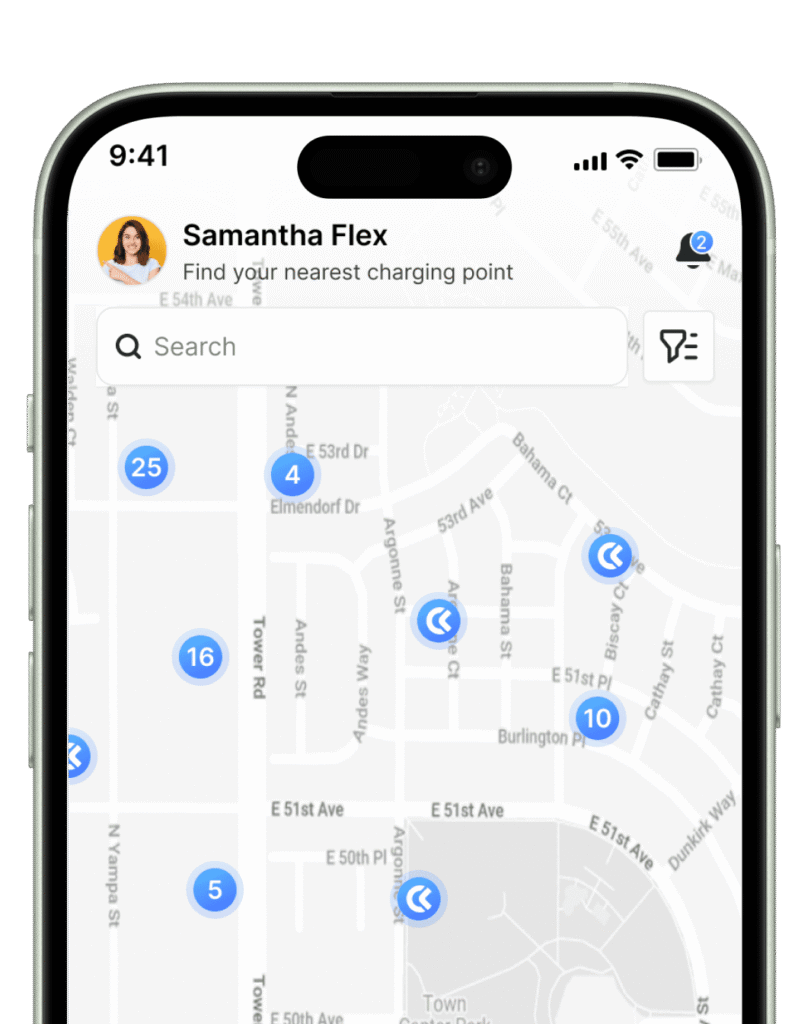
The app allows users to find public charging stations, view information about them, plan trips, and use other EV-related features.
Yes.
The Circle Link map includes public EV charging stations in Lithuania and other countries. You can view their location, connector types, charging power, operator, and other available information.
When the charging operator provides real-time data, Circle Link may display the availability status of the charging station or individual connector.
Data availability depends on the specific charging operator and its integration.
Yes. At supported public charging networks connected to Circle Link, you can start a charging session and pay directly through the Circle Link app.
Specific prices and payment conditions depend on the selected charging operator and charging station.
Yes.
Circle Link allows you to plan EV journeys and find suitable public charging stations along your route. This combines navigation, route planning, and charging station search within a single app.
Yes.
After selecting your destination, you can search for suitable charging stations along the route and plan charging stops according to your journey requirements.
Before travelling, it is recommended to consider:
* charging station power;
* compatible connector types;
* real-time availability;
* operator pricing;
* estimated charging time.
Yes.
Circle Link combines the main needs of an EV driver in a single app:
* DAEI accounting for home and business charging;
* tracking accumulated DAEI benefits;
* public charging station search;
* charging station information and availability;
* payment for charging at supported networks;
* EV-specific navigation,trip and charging-stop planning;
This means Circle Link can be used for everyday home charging, public charging, and longer EV journeys.
Find help on supported chargers, payments, compatibility, and how Circle Link works.
Join Us!